

The Realms of the Unseen
A Counter-Archive, created between 2019 and 2025 on seventeen years of UNSEEN state sanctioned violence and police violence in the Netherlands

So where is God?
From a destroyed collection, orig. pastel on paper 50 x 70 cm 1997
Motivation and background
The artworks in this archive were never made to be published, they are the results of a very personal process that started in 1992 to transform personal struggles and feelings from my childhood into images.
The driving force behind publishing this archive and creating this website is explained as follows:
When a state refuses to grant restorative and reparative justice for those many citizens who paid with everything they had—losing their parents, children, family, home, childhood, identity, and future—with a government that actively concealed these life stories, while blaming the victims for the complex consequences of state -sanctioned violence and neglect -making that reality visible becomes an act of absolute necessity.
My experience with state sanctioned violence, neglect and erasure in childhood is similar to the ten thousands of other children that were forced into the youth care system. This state system is often still very oppressive and violent today, creating the discarded lives of tomorrow.
Despite official governmental apologies in 2019 following the Dutch De Winter Committee, investigating violence in the youth care system whose report was euphemistically entitled "Insufficiently protected", the Dutch government still shows deep contempt for the victims of their actions. The truth is, we were never protected by the government.
Unseen
Like many care leavers experienced, the Dutch system actively protected the abusers and further complicated my life,:
- In 1995, The Dutch state honored the foster mother who abused three foster children with a State Medal in the Order of Orange Nassau (Digibron 14-09-1995, Goud Woudenberg).
- The official criminal complaint filed by my brother and me in 1996 (within the legal term) against the foster parents was dismissed by the Public Prosecutor as sepot 41 (insufficient grounds to investigate). The complaint included war -techniques by the foster father against his foster children from the Dutch -Indonesian war of 1949, such as described in " De brandende Kampongs van Generaal Spoor" by Rémy Limpach, 2016)
- Although tested for the highest academic track (VWO) in primary school, the foster parents deliberately obstructed my chances for education by sending me to a lower - tier school. In later life the official rules blocked my chances to study in the Netherlands
- Five years after leaving the system, in 1986, I was confronted with antisemitic rhetoric and Nazi based methods by the Dutch police, a direct consequence of a life in the youth care system, resulting in complex identity problems
- I have been actively rejected by all Dutch mental health care organizations for almost my entire life. The mental health care system acted as an extension of the government policy of oppression and marginalization. Organizations for support such as MIND and Slachtofferhulp choose the side of the government
- Rejectedt from all diversity and inclusion organizations in the Netherlands because an LGBTQ+- identity should be 'born this way'. A lifelong, persistent blueprint from (state) imposed issues is 'invalid'.
- Like many thousands, we never received any reparative justice (support, education, participation, rehabilitation or protection) after state care. This creates a frozen life reality- a life that never really starts.
This archive is a testimony of what I personally experienced as a continuous, lifelong war in "peacetime" in the Netherlands. The human rights violations (ECHR 3 and8) by the Dutch state from 1964 to 1981 and 1986 have been included in the newsletter of the EG (European Group of Deviance and Social Control) .
A formal petition to the European Union regarding the human rights violations by the Dutch state under case number 0754/2026 was dismissed by the European Union in 2026.
Recognition and Apologies
Contrarily, formal recognition about the institutional violence was given by independent official bodies in the Netherlands.
- Schadefonds Geweldsmisdrijven (Dutch government injury Compensation Fund) The violence in youth care 1964-1981 was recognized in category 6 - most severe violence) - in 2020, after 39 years. The 1986 police sexual violence was also recognized in the category of most severe violence (category 6 of Schadefonds) in 2026 , after 4O years. These two separate cases of governmental violence however were merged to avoid financial compensation, support and rehabilitation. The ECHR art 3 violations are thus covered up again.
- Official personal apologies were received from Pleegzorg Nederland (Dutch Foster Care) and the Raad voor de Kinderbescherming (Child Protection Council), in 2018 and 2019 published in " Gepleegd", written under the pseudonym Jasper Heijting
About the Archive
The approximately 600 artworks in this archive span a period of six years (2019-2025) and are the saved part of a much larger collection. Early art has been destroyed in 2002 and later in 2018, comprising hundreds of works including many 3D objects.
In addition to the work in the archive, 13 original photographs show a lived reality.
This archive coexists alongside the autobiographical books Gepleegd and Hoe word ik Tim? written under the pseudonym Jasper Heijting, see in the section Published Books on this page with a download link to the book Gepleegd.

So this is freedom? Pastel 50 x65 cm from Identity restoration studio 2023
Content Warning
This archive contains raw spontaneous depictions of institutional violence and trauma, that some people may find disturbing.
archive #1 Institutional violence,youth / foster care 1-45
archive #2 Institutional violence, foster care 46-98
archive #3 Police violence and article 3 ECHR [1986] 99-120
archive #4 Institutional violence, youth / foster care 121-162
archive #5 Trauma Art and the Body 163-185
archive #6 Institutional violence, youth and foster care 186-232
archive #7 Institutional violence in foster care: Gender Based Violence 233-280
archive #8 Institutional betrayal and violence in foster care 281-325
archive #9 Trauma art about youth care and violence in foster care 326-377
archive #10 Trauma art about violence in foster care 378-428
archive #11 Trauma art 1992-1997 (Portraits, early / Residential) 429-486
archive #12 (Project) Photographs and artwork: "Stigma by Design: The Enduring Pulse of the State 487-538
archive #13 Trauma art on institutional violence 541- 617
PUBLISHED ZINES

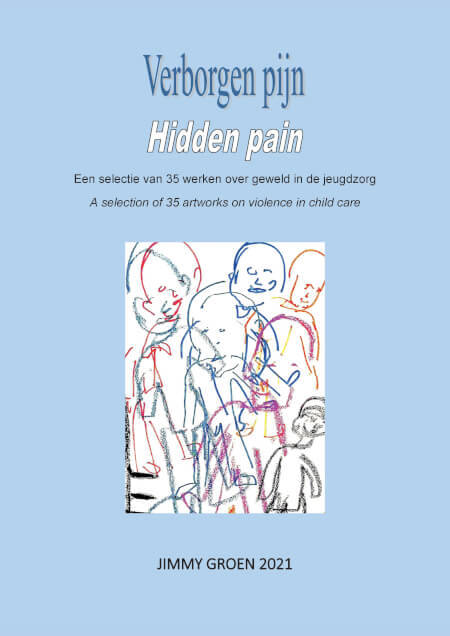
Hidden pain 35 Works on Violence in the Dutch Youth Care System
English, French, Dutch
2021 EAN 9789464431926
Published books by Jimmy Groen written under the pseudonym
'Jasper Heijting'
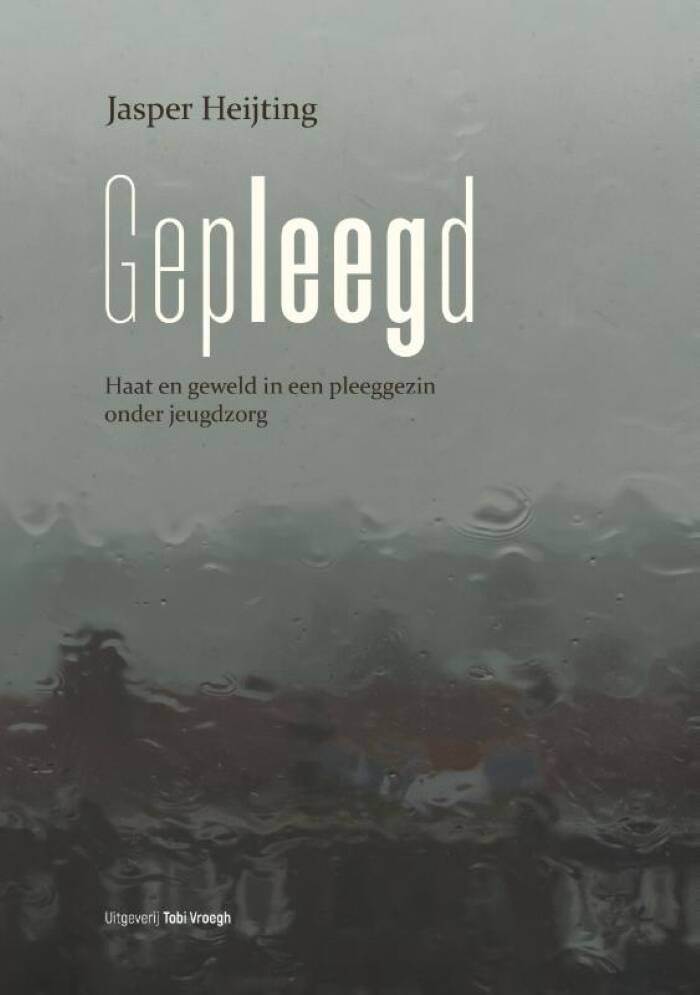
Gepleegd [English title: Committed] Gepleegd, published by Tobi Vroegh Amsterdam
Editors: Ilona Barsony, Claire Hülsenbeck, Anouk de Jong, Rohan Karbet
Executive Summary
Jasper Heijting's 2020 ego document, Gepleegd, ["Committed"] offers a candid, firsthand account of enduring long-term abuse and torture within the Dutch foster care system. This autobiography highlights the author's struggle with extreme trauma, imposed gender issues and fragmentation of the mind, written from the child perspective. The book provides crucial context for understanding Jimmy's trauma art archive.
Language: Dutch
Available in the libraries of the Netherlands and Flanders and bookstores.
2020 EAN 9789078761785
Read the first revised chapter of this book in English
A first raw translation in English of the book Gepleegd (Committed) was created by AI (€96,-); this translation is not perfect but offers a profound insight in the basic story of the archive. It is free available on terms of CC BY-NC-ND (2026)
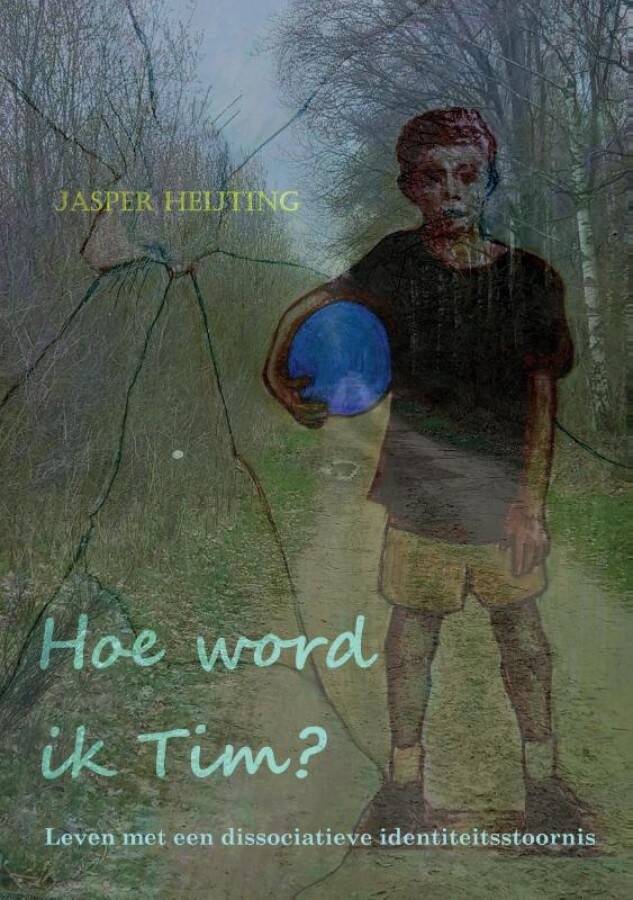
Executive Summary
Hoe word ik Tim? ("How Do I Become Tim?") is the second volume of Jasper Heijting’s ego-documentary series. It traces the lifelong confusion of state-sanctioned identity destruction and imposed attachment issues, and details the psychological phenomenon of a fragmented inner world. In 1998 Jimmy was officially labeled with a 'dissociative identity disorder (DID,) but never received any mental health care or support.
The book describes the desperate search to become a boy, after foster care, the exclusion from society and mental health care, the problems with time, age and belonging, and finally the construction of a tangible Realm of Boys to live in.
Most importantly, this volume documents the exact historical turning point where the author begins to use raw visual art as his sole mechanism for survival when all societal, medical, and legal institutions utterly fail him. The story itself is a metaphor for a fragmented identity.
Language: Dutch. Image cover: Jo Coort
Available in the library of Flanders (Belgium) and bookstores.
2021 EAN 9789464068153