

The Realms of the Unseen
A Counter-Archive, created between 2019 and 2025 on seventeen years of UNSEEN state sanctioned violence and UNSEEN police violence in the Netherlands
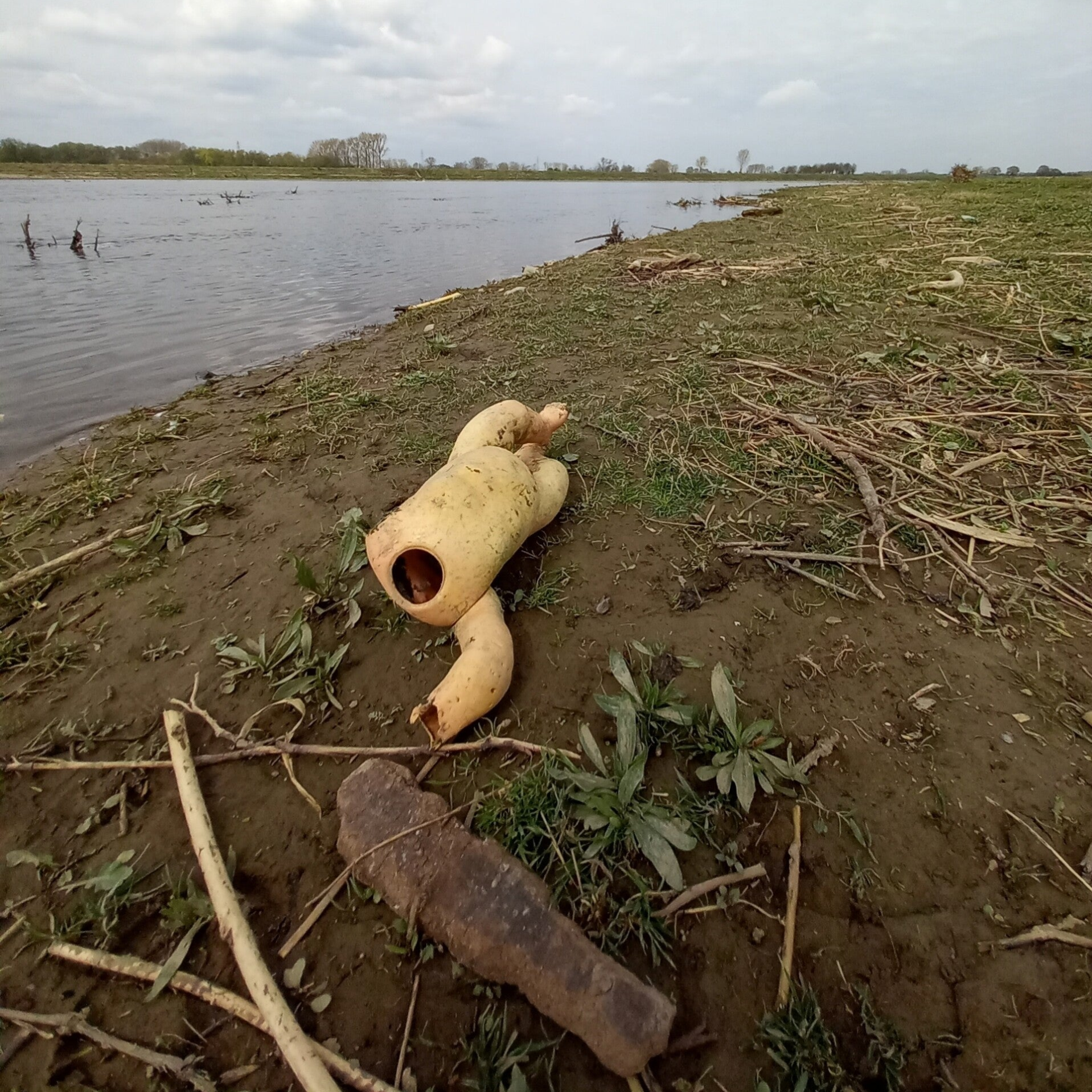
The State’s Wreckage
Aged out of care, left at the edge.
Photography 2020
Motivation and Background
The artworks in this archive were never originally made to be published. They are the result of a deeply personal process that began in 1992, transforming childhood struggles and complex emotions into images. However, creating this archive became an act of absolute necessity. When a state refuses to grant restorative and reparative justice to those citizens who paid with everything they had—losing family, identity, and their future—and when a government actively conceals these stories while blaming the victims, making that reality visible is no longer optional. It is a duty. My experience with state-sanctioned violence, neglect, and erasure is identical to that of tens of thousands of other children all over the world forced into a youth care system that promised 'to do better than the parents'. Instead, it destroyed lives and they treated us as their ultimate enemies. All institutions in the Netherlands cowardly ran away from their responsibilities, especially the mental health care organizations. Despite official governmental apologies in 2019 following the so called Dutch De Winter Committee — whose report was euphemistically titled "Insufficiently Protected"—the Dutch government still shows deep contempt for victims. The truth is simple: we were never protected by the state, not even a second. The truth was the opposite: we were the intended target of violence, hatred and erasure.
Unseen: A Lifelong War in Peacetime
Like many care leavers, I experienced a system that actively protected abusers and institutionalized marginalization. This archive serves as a testimony to a continuous, lifelong war in "peacetime" within the Netherlands:
- State-honored abuse: In 1995, the Dutch state honored the foster mother who abused three foster children with a State Medal in the Order of Orange-Nassau. Reference: Digibron 14-09-1995 Gedenkwaardig goud (Ms W. C. Franken-van Daatselaar from Woudenberg)
- Dismissed justice: A criminal complaint filed in 1996 within the term- with my brother- against the foster parents was dismissed under the Dutch classification 'sepot 41', meaning considered too insignificant to investigate. The abuse during thirteen years included military war-techniques of torture, used by the foster father, derived from the Dutch-Indonesian war of 1949.
- Obstructed future: Despite testing for the highest academic high school track (VWO), my education was deliberately blocked. In later life, official systemic rules prevented me from studying in the Netherlands.
- Police violence, fascism & antisemitism: In 1986, five years after leaving the system, I was subjected to police sexual/ educational violence, antisemitic rhetoric, and Nazi-based methods—resulting in irreversible identity trauma and lasting injury.
- Systemic rejection: While I was diagnosed with a label 'dissociative identity disorder' in 1998, in the past decades, I have been systematically rejected by all Dutch mental health organizations (GGZ) and support groups like MIND and Slachtofferhulp, which acted mostly as extensions of government.
- Exclusion from diversity spaces: Rejected by all Dutch diversity and inclusion organizations because they claim an LGBTQ+- identity should strictly be 'born this way', invalidating a lifelong blueprint of state-imposed trauma.
- A frozen life: Like thousands of others, the denial of reparative justice (rehabilitation, specialized care, education in later life) has created a 'frozen reality'—a life that is never allowed to truly begin.
Note: These human rights violations (ECHR Articles 3 and 8) were officially reported to High Commissioner for Human Rights (OHCHR) and documented by the European Group for the Study of Deviance and Social Control. A formal petition to the European Union (case 0754/2026) was dismissed in 2026.
Official Recognition
Paradoxically, the institutional violence was officially recognized by independent bodies, though true justice remains blocked:
- Schadefonds Geweldsmisdrijven (Compensation Fund Violent Crimes): The youth care violence (1964-1981) and the 1986 police violence were both recognized under Category 6 (the most severe violence) in 2020 and 2026. However, the state retroactively merged these two completely separate historical cases—each involving distinct physical and psychological trauma—into a single claim. This bureaucratic maneuver was used to evade fair financial compensation, specialized medical rehabilitation, and targeted psychological support. It was used to make the nazi based police torture invisible in statistics. A download of this recognition is published at this page
- Official Apologies: Formal apologies were issued by Pleegzorg Nederland (2018) and the Raad voor de Kinderbescherming (2019), as published in the book Gepleegd under the pseudonym Jasper Heijting.
About the Archive
This archive contains approximately 600 artworks spanning the period of 2019–2025. They represent the surviving remnants of a much larger collection; hundreds of earlier works and 3D objects were destroyed in 2002 and 2018. The archive reflects the chaotic nature of trauma, shifting between the harsh structural realities of state oppression and the collaborative creations born within the sovereign, protective sanctuary of the Realm of Boys.
Alongside the artwork, 13 original photographs document this lived reality.
This visual archive coexists with the ego -documents Gepleegd (Committed) and Hoe word ik Tim? (How do I become Tim?), written under the pseudonym Jasper Heijting. A download link to Gepleegd in English language can be found in the 'Published Books' section on this page.
The archive pages
archive #1 Institutional violence,youth / foster care 1-45
archive #2 Institutional violence, foster care 46-98
archive #3 Police violence and article 3 ECHR [1986] 99-120
archive #4 Institutional violence, youth / foster care 121-162
archive #5 Trauma Art and the Body 163-185
archive #6 Institutional violence, youth and foster care 186-232
archive #7 Institutional violence in foster care: Gender Based Violence 233-280
archive #8 Institutional betrayal and violence in foster care 281-325
archive #9 Trauma art about youth care and violence in foster care 326-377
archive #10 Trauma art about violence in foster care 378-428
archive #11 Trauma art 1992-1997 (Portraits, early / Residential) 429-486
archive #12 (Project) Photographs and artwork: "Stigma by Design: The Enduring Pulse of the State 487-538
archive #13 Trauma art on institutional violence 541- 617
PUBLISHED ZINES

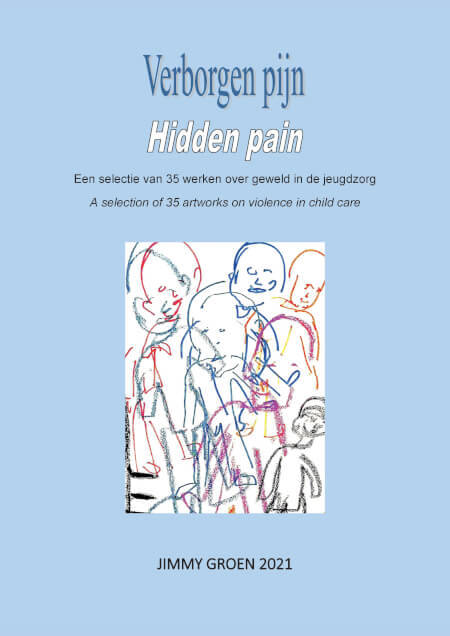
Hidden pain 35 Works on Violence in the Dutch Youth Care System
English, French, Dutch
2021 EAN 9789464431926
This zine is dedicated to my brother Harry, who lived homeless on the streets for 22 years after he left foster care. Harry froze to death alone next to a church, and was buried on Christmas Eve in Nettetal, Germany in 2009, at the age of 42.
Published books by Jimmy Groen written under the pseudonym
'Jasper Heijting'
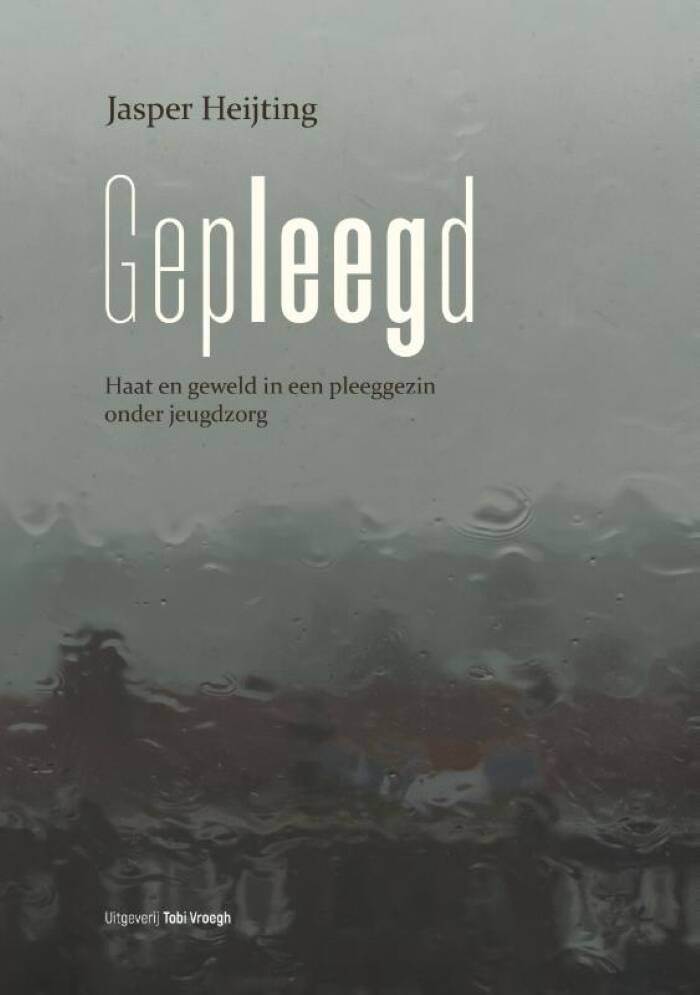
Gepleegd [English title: Committed] Gepleegd, published by Tobi Vroegh Amsterdam
Editors: Ilona Barsony, Claire Hülsenbeck, Anouk de Jong, Rohan Karbet
Executive Summary
Jasper Heijting's 2020 ego document, Gepleegd, ["Committed"] offers a candid, firsthand account of enduring long-term abuse and torture within the Dutch foster care system. This autobiography highlights the author's struggle with extreme trauma, imposed gender issues and fragmentation of the mind, written from the child perspective. The book provides crucial context for understanding Jimmy's trauma art archive.
Language: Dutch
Available in the libraries of the Netherlands and Flanders and bookstores.
2020 EAN 9789078761785
Read the first revised chapter of this book in English
A first raw translation in English of the book Gepleegd (Committed) was created by AI (€96,-); this translation is not perfect but offers a profound insight in the basic story of the archive. It is free available on terms of CC BY-NC-ND (2026)
Executive Summary
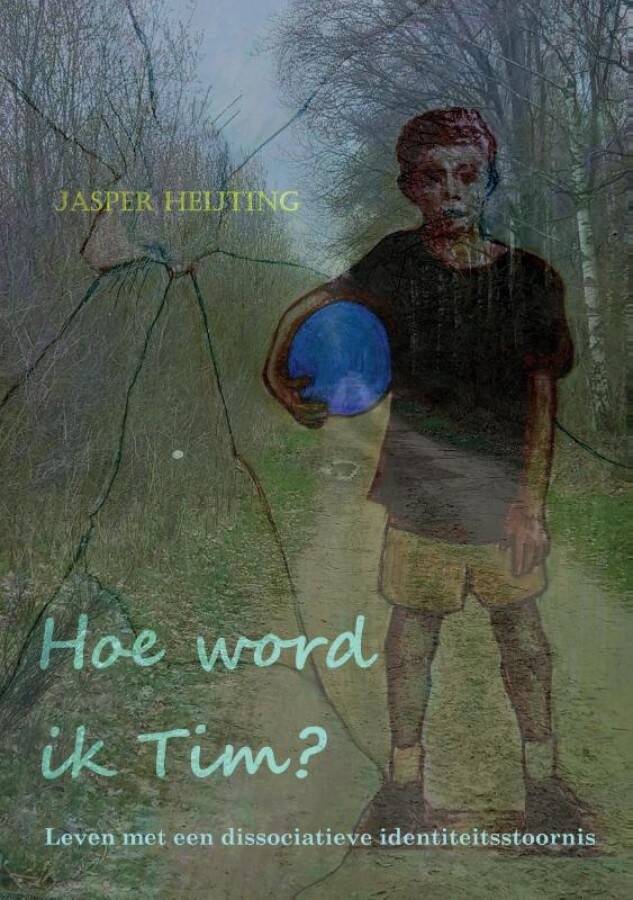
Hoe word ik Tim? ("How Do I Become Tim?") is the second volume of Jasper Heijting’s ego-documentary series. It traces the lifelong confusion of state-sanctioned identity destruction and imposed attachment issues, and details the psychological phenomenon of a fragmented inner world. In 1998 Jimmy was officially labeled with a 'dissociative identity disorder (DID,) but never received any mental health care or support.
The book describes the desperate search to become a boy, after foster care, the exclusion from society and mental health care, the problems with time, age and belonging, and finally the construction of a tangible Realm of Boys to live in.
Most importantly, this volume documents the exact historical turning point where the author begins to use raw visual art as his sole mechanism for survival when all societal, medical, and legal institutions utterly fail him. The story itself is a metaphor for a fragmented identity.
Language: Dutch. Image cover: Jo Coort
Available in the library of Flanders (Belgium) and bookstores.
2021 EAN 9789464068153